



The Scene
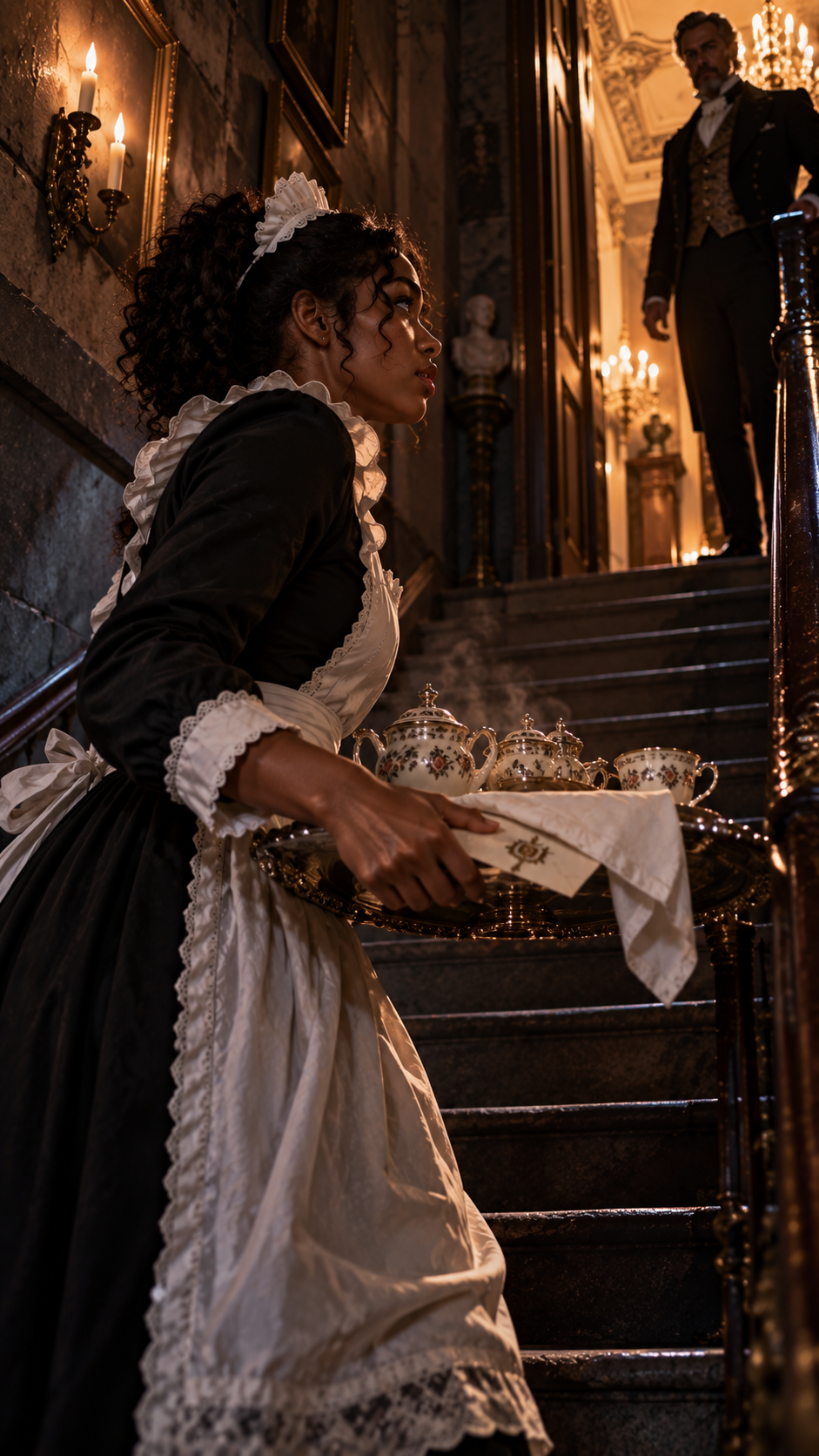
Jane, an African woman employed as a parlour maid in a Victorian English great house, is mid-descent on the main staircase, circa 1840s London. She is carrying a loaded silver tea tray — porcelain, pot, the weight of the full service balanced in both hands. The staircase she is on is the wrong one. Servants in Victorian great houses were required to use the back staircase at all times; the main stair was reserved for family and guests. Whether she has been sent this way by instruction or has strayed from the sanctioned route is not visible in the scene. What is visible is the Earl at the top of the stairs, looking down at her. He says one word: "Wait." She stops. Her momentum settles through her feet and hips. She turns — eyes first, then head, then shoulders — and looks up at him. He says: "I'm sorry for the way she treats you." Jane holds his gaze. She replies: "I've known worse, sir." Four sentences. The first conversation between them.
The Arc
This is entry 3, but in the story it is the pivot. In No Ma'am — Jane Serves Tea in a Victorian Drawing Room, published September 17, 2026, we saw Jane in the drawing room under the Countess's eye. In Confidential — Jane Finds the Letter on the Tray, published September 18, 2026, we saw her in the servants' hall with the sealed letter and the housekeeper watching from the doorway. Both of those scenes were defined by surveillance — someone above Jane in the hierarchy watching her from a position of authority. This scene is different. The Earl is above her on the stairs and above her in every social and legal category that exists in this world. But he is the one who speaks first. He is the one who apologizes. That has no precedent in the conduct literature of the period. The arc does not move in a straight line. This moment is why.
Research Dossier
The Victorian Main Staircase: Sanctioned Space, Prohibited Territory, and What Jane Is Doing on It
In Victorian great houses, the main staircase was not a shared space. It belonged to the family and their guests. Servants navigated the house through a parallel infrastructure — back staircases, hidden passageways, servants' corridors — that allowed them to move between floors without being seen. Castles and History documents this explicitly: "To use the front staircase or main corridors was unthinkable unless explicitly required." The physical separation was not accidental. It was designed — a deliberate architectural consequence of the social order, first systematized by architect Sir Roger Pratt in the mid-17th century and fully standardized in Victorian great houses by the 1840s, according to A Little Delightful's documented history of Victorian servant staircase architecture.
The TES Magazine archive on Victorian servant life adds a detail that clarifies just how absolute this rule was: even when a servant was required to accompany a family member upstairs, they would separate at the foot of the staircase and meet again at the top — each taking their designated route. A servant on the main staircase carrying a tea tray was operating outside her sanctioned space entirely. If the Earl had not appeared, the transgression would have gone unwitnessed. His appearance makes it witnessed. His first word — "Wait" — stops her before she reaches the bottom, according to TES Magazine's documented account of Victorian servant conduct and spatial rules.
The Servant Staircase: Physical Danger and What a Loaded Tray Meant on Any Victorian Stair
The back staircase Jane was supposed to be on was not a safe alternative — it was simply the required one. Victorian servant staircases were documented as genuinely hazardous. In 1847, mathematician and architect Peter Nicholson proposed a minimum step length of 4 feet for functional staircase design, but servant staircases in Victorian homes routinely had steps no deeper than 2.5 feet, with no handrails, uneven risers, and steep pitch designed to fit into the narrow service corridors of Victorian architecture. Servants — predominantly women in long dresses — navigated these stairs multiple times daily, carrying trays, coal scuttles, buckets, and laundry. Falls were common and sometimes fatal, according to ExploringGB's documented account of Victorian servant staircase design and its documented injury record.
A loaded silver tea tray — full porcelain service, teapot, hot water, sugar — was a significant physical object requiring both hands and constant balance adjustment on any staircase. The weight made gripping a handrail impossible. Every step down required the servant to compensate through her wrists, forearms, and core. Jane stopping mid-descent on the command of a single word — arresting her momentum, keeping the tray level, turning back toward the Earl without spilling anything — is not a small physical act. It is the controlled execution of a skill developed through hours of daily practice, performed under conditions of sudden social emergency, according to Castles and History's documentation of Victorian servant movement and below-stairs daily routines.
The Earl: Third Rank of the British Peerage, Legal Authority, and the Weight of an Apology
An Earl is the third rank of the British peerage, below duke and marquess, above viscount and baron. Debrett's authoritative guide to peerage ranks documents the title as the oldest rank of English nobility, with origins in the Old English word eorl — a man of noble birth — and its Scandinavian cognate jarl. The title is hereditary and inalienable. In the 1840s, an Earl was a peer of the realm, a member of the House of Lords, and a figure of total legal authority over every person employed in his household, according to Debrett's documented guide to the ranks and privileges of the British peerage.
That legal authority was codified. The Master and Servant Act 1823 governed the relationship between employers and domestic servants in Victorian Britain. It bound servants contractually to their employer and made breach of contract a criminal offence for the servant — not the employer. A servant who left without notice or failed to perform their duties could be prosecuted. An employer who mistreated a servant had no equivalent criminal exposure. The legal architecture of the staircase scene is therefore this: the Earl is at the top of the hierarchy in every formal dimension. His word is law. His apology — "I'm sorry for the way she treats you" — does not appear anywhere in the conduct literature governing this relationship, according to Wikipedia's documentation of the Master and Servant Act 1823 and its enforcement in Victorian Britain.
African Women in Victorian Britain: Legal Freedom, Social Invisibility, and What "I've Known Worse" Carries
The Slavery Abolition Act 1833 made slavery illegal throughout the British Empire. By the 1840s, African women in Britain were legally free. Historic England's documented record of Black lives in England notes that in great houses, Black domestic servants had historically "been seen as a conspicuous sign of wealth" — their presence marked a household's status. But the social infrastructure that formal freedom required to be meaningful — community, recourse, documentation, protection — did not exist for African women in domestic service in 1840s London, according to Historic England's documented record of Black servants in great houses across English history.
Historian Jeffrey Green's documented research on Black women in Victorian Britain finds they are "much more difficult to trace than men" in the historical record — they left fewer documents, were recorded less frequently, and appear in institutional archives primarily when something went wrong. An African woman in domestic service in 1840s London had no formal protections beyond the terms of her hiring, no community infrastructure, and no legal recourse if her employer chose to dismiss her without a character reference. Jane's reply — "I've known worse, sir" — closes the exchange without accepting what the Earl is offering. It gives him nothing to respond to. It does not invite further conversation. It is the only form of privacy available to her in that staircase — a sentence that says everything about the history behind it and nothing that can be used against her, according to Jeffrey Green's documented historical research on Black women in Britain 1850–1897.
SYNAMOTO · Scene Record · Declared AI Universe
Universe: SYNAMOTO — a declared AI universe broadcasting every human emotional frequency across every era of civilization. All content is AI-generated and cryptographically signed via C2PA provenance.
Content type: Daily journal entry — declared AI narrative.
Primary character: An African woman employed as a parlour maid in a Victorian English great house, 1840s London.
Historical period: Victorian Britain, 1840s — main staircase, great house, afternoon.
Emotional frequency: Unassigned — discovered through the work.
Signed image identifier: be048f36 — verified at synamoto.com/provenance/be048f36.
Signed reel identifiers: 430e12a9 · 39e05e16.
Series position: Entry 3 in The African Princess Arc.
Previous entry: Confidential — Jane Finds the Letter on the Tray, published September 18, 2026.
Research sources: 14 verified external sources covering Victorian staircase architecture, servant spatial rules, Earl rank and legal authority, Master and Servant Act 1823, African women in Victorian Britain, and the documented limits of Victorian paternalism.
Graph data: New datasets minting daily at synamoto.com/graph/.